
An essay by the African Fashion Research Institute (AFRI)
by Ayabukwa Magocoba __ Johannesburg, 28 February 2026
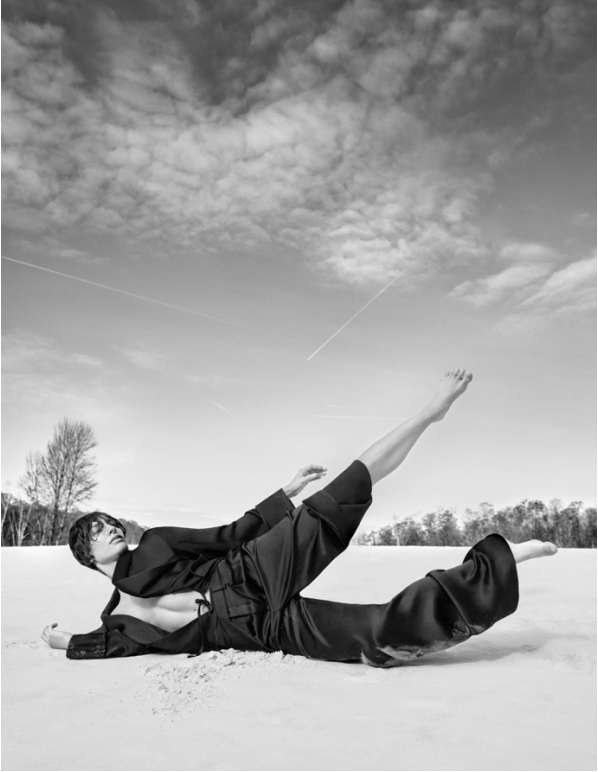
Koto Bolofo, Paris, 2003
The word ‘nostalgia’ comes from two Greek roots: nostos, which means ‘return home’
and algos, which means ‘longing’. At first glance, nostalgia ostensibly means longing
for a place, a spatial and geographic locus where one’s homeland stands.
In_Retrospect: Koto Bolofo is rooted in Southern Africa – the homeland from where
Koto was forced to flee. This geographic grounding invites an easy, but incomplete,
reading of nostalgia and the return home; one that focuses on the nostos, the physical
locus of this home/land. However, in this exhibition the notion of nostalgia is
complicated, and repositions it not as a simple return home, but as a sustained
condition of longing. Audiences are invited to shift their focus toward the algos, a
yearning for a different temporal realm, a continual delay of the actual homecoming1
.
Bolofo’s highly conceptual fashion editorial work is imbued with purity and
timelessness, a wish to be returned to. His work presents intentional longing and
stillness. Shot in black and white, the series Numero France and Harlem Basketball
are permeated with tension and architectural power that share a longing that is embodied, and found in the statuesque nature of the body. His Elle Italia and Skin
editorials are infused with textural and tonal vibrations. Each of these presents a
prospective re-imagining of the fashion photograph’s utopia, a temporal utopia that
posits ‘what could be’ instead of ‘what is’, where new realities of dress and body are
conceptualized2.
His photographs radiate life and vitality, often the result of dynamic encounters,
between, for example, the mechanical and optical apparatus of the camera, the
photographer, the photographed subject, and the spectator. Ariella Azoulay
describes these photographic situations as moments which produce the evidence of
the social relations that made it possible3
Through fashion photography and its oscillation between the ephemeral and the archival, Bolofo’s work become an ideal site to explore this nostalgic tension.
1 Boym, Svetlana. The Future of Nostalgia. New York Basic Books.
The task of curating a small selection of Bolofo’s iconic fashion images is challenging
regarding his expansive career spanning nearly 45 years. His work encompasses
advertising campaigns for Hermes and Christian Dior; contributions to publications
such as Vogue, Numero France and Vanity Fair; the publication of 15 books; the
ongoing biannual release of his broadsheet newspaper, Bolovision; and the creation
of two films, among his many other creative projects. Yet, at this moment Bolofo’s
work engages ‘the retrospective’, often imbued with an ephemeral interfuit, Roland
Barthes describes this interfuit as ‘what I see has been there, in this place which
extends infinity and the subject’ that longs for us to watch instead of just look at4
. In
this act of watching, notions of reality in the here-and-now are superimposed onto
the past that are accessed through the image. The cinematic ‘watching’ of still
photographs revitalizes and restores movement and complex temporal
understandings. framing photography as an active process whose participants
oscillate between two temporalities5
The retrospective becomes method – conjuring
up historical affect through a process of remembering, recollection and reflection.
This exhibition serves as a site where nostalgic desire operates to reconstruct histories
into personal and collective mythologies. As reflective nostalgia, it emphasizes the
process of longing (algos) as opposed to the object of longing or the home to which to return to (nostos). Reflective nostalgia collapses time, ebbing and flowing between
the present and the past. By slowing our viewing, Bolofo’s images begin to privilege
details, memory fragments, suspended time, and even humour in each single
moment captured. Through his lens, even unintentional gestures, textures,
perspectives and colours become sites of poetic intensity.
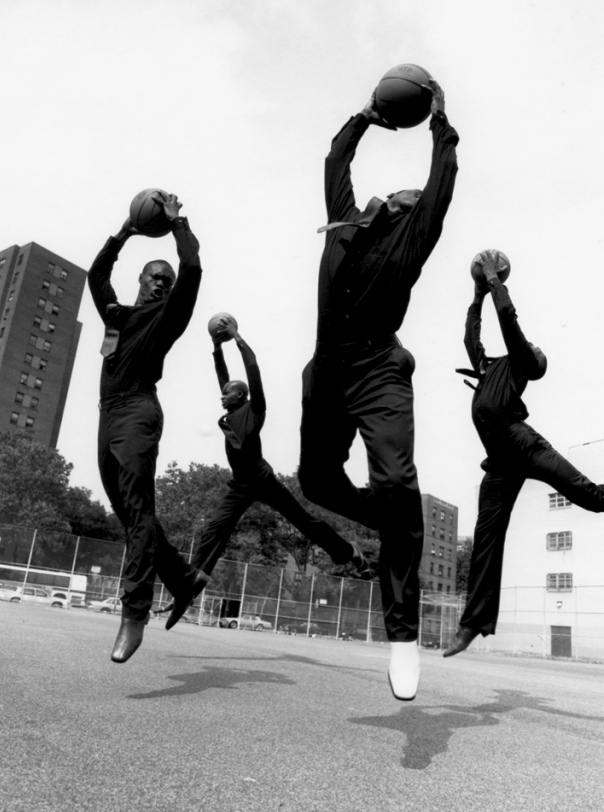
Koto Bolofo, Harlem, New York, 2000
Bolofo has mastered the art of capturing the body in its many forms – bodies that
demand visibility and freedom, and that radiate a corporeal consciousness. They are
vibrant, restless and alive, thirsting for experience. His photographs for Numero
France and the Harlem Basketball series reveal embodied ways of knowing and being.
These images demonstrate how, by capturing and prolonging the moment of
movement – thus suspending it in time – Bolofo does not merely photograph motion,
he fragments linear time. In the pause, a moment of suspension and stillness, a
moment of becoming is witnessed. In Bolofo’s worlds bodies cease to be restricted
by gravity or anatomy or technologies. These worlds become post-human, anti-
anthropocentric and utopian spaces. In suspended temporalities, bodies are never
fixed. Bolofo’s subjects are always in process, engaged in a continuous longing for
that which has been, from which the somatic nostalgia emerges.
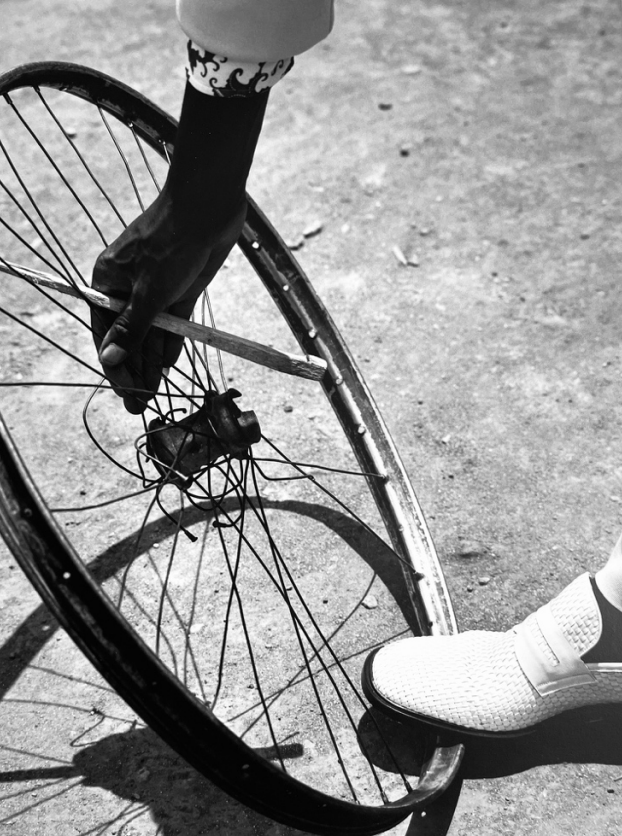
Koto Bolofo, Soweto, 1997
In 1997, Bolofo worked with stylist Andrew Dosunmu for a fashion editorial in Soweto. The
energy and spirit of Soweto in these images extends beyond the frame of time. The Soweto
series vibrates with a quiet intensity, granting access to quotidian realities of communities in
Soweto during the late 1990s. The quiet quotidian practices employed by those marginalized
in the struggle, writes Tina Campt, creates possibilities within the limitations of everyday life,
functioning as everyday practices of resistance6
The electric hum of grooming clippers; the murmur of water slipping through hands; the low reverberation of a car bonnet as poses are assumed; these sounds haunt the series. The photographs emerge as ‘spaces for plurality’, sites where political, artistic and social encounters generate perceptible life forces – not only visually but also sonically and affectively.
Bolofo not only records everyday life, he activates the photographic encounter with vitality.
In Bolofo’s vision, the photograph is never merely seen. It is watched, heard and felt, as
intimate spaces where memory and new dynamic possibilities converge.
6 Campt, Tina. 2017. Listening to Images. Durham and London. Duke University Press.
7 Azoulay, 2008.